Key Takeaways
- Modern vessels are connected digital ecosystems, making cybersecurity essential for safe and resilient operations.
- Compliance is the foundation, not the finish line. Meeting IMO and IACS requirements alone does not eliminate cyber risk.
- Layered cybersecurity (defense in depth) combines multiple security controls to prevent, detect, respond to, and recover from cyber incidents.
- A secure digital foundation starts with network segmentation, identity management, secure remote access, and IT/OT separation.
- Continuous monitoring with IDS, SIEM, AI analytics, and SOC support improves threat detection and enables faster incident response.
- Cyber resilience depends on preparation, including incident response planning, backup and disaster recovery, risk assessments, and continuous improvement.
- People remain a critical layer of defense. Regular cybersecurity awareness training and operational exercises help reduce human-related risks.
- Integrated cybersecurity ecosystems provide centralized fleet visibility, simplify security management, and strengthen cyber resilience across multiple vessels.
Cybersecurity has entered a new era
Modern vessels have become highly connected digital environments where navigation systems, cargo operations, communications, operational technology (OT), business applications, cloud services, remote maintenance, and crew welfare platforms continuously exchange data.
However, every new connection also introduces another potential entry point for cyber threats.
The maritime industry is experiencing a noticeable increase in cyber incidents. At the same time, regulatory expectations have evolved. The IMO’s cyber risk management requirements established cybersecurity as part of every vessel’s Safety Management System, while IACS Unified Requirements E26 and E27 have shifted the industry’s attention toward cyber resilience throughout a vessel’s entire lifecycle.
As a result, the conversation has changed.
The question is no longer:
“How do we prevent every cyber attack?”
Instead, fleet managers are asking:
- Can we detect threats before operations are disrupted?
- Can we isolate affected systems?
- Can we continue operating safely during an incident?
- Can we recover quickly
- Can we demonstrate cyber resilience during audits?
Answering these questions requires much more than deploying individual security products. It requires a layered cybersecurity strategy.
Compliance is the starting point - not the destination
Regulations provide a structured framework for identifying risks, implementing controls, and documenting cybersecurity processes.
However, compliance alone does not stop cyberattacks.
A vessel may satisfy regulatory requirements while remaining vulnerable to phishing campaigns, ransomware, compromised remote access, outdated software, insider threats, or third-party supply chain attacks.
Cyber threats evolve continuously and this is why the goal is to build operational cyber resilience.
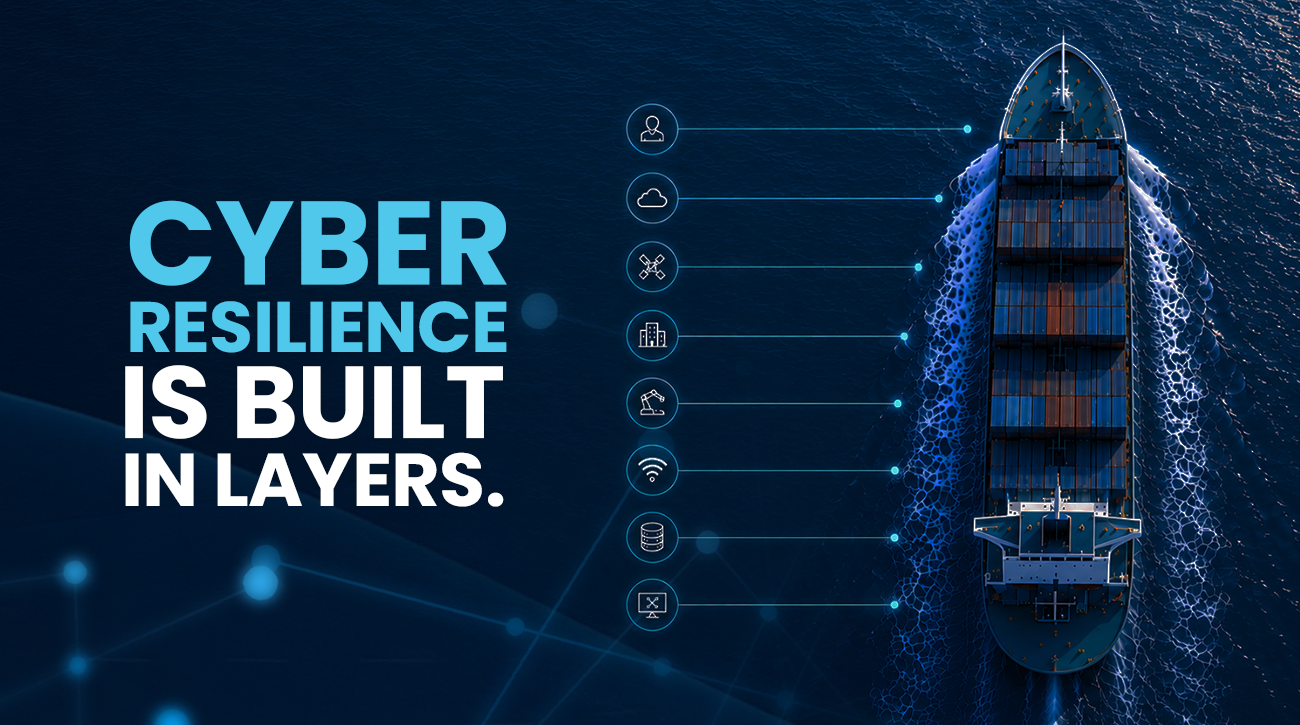
Layered cybersecurity
Layered cybersecurity – often referred to as defense in depth – is built on a simple principle:
No single security technology can stop every cyber threat.
Instead of depending on one firewall, one antivirus solution, or one security appliance, multiple independent security controls work together across the vessel’s infrastructure.
Each layer has a different purpose:
- Prevent attacks
- Detect suspicious activity
- Respond quickly
- Recover safely
- Continuously improve security
If one control is bypassed, another continues protecting the vessel.
Building a secure digital foundation
Every cybersecurity strategy begins with the vessel’s infrastructure.
Today’s ships connect hundreds of devices across bridge systems, communications networks, and corporate applications. Without proper network architecture, a compromised device can allow attackers to navigate across multiple onboard systems.
Building a secure foundation starts with reducing the attack surface through:
- Network segmentation and policies
- High-performance firewalls
- Separation of IT and OT environments
- Secure remote connectivity
- Identity and access management
- Multi-factor authentication (MFA)
- Privileged access controls
- Zero trust principles
Modern vessels depend on remote access for maintenance and technical support. Securing both the network and the identities, it creates the first line of defense against cyber threats.
Protecting systems through continuous monitoring
Most cyber incidents begin at an endpoint, but they are often detected only after they have spread across the network.
Protecting modern fleets therefore requires both strong endpoint security and continuous visibility across vessel operations:
- Endpoint protection
- Antivirus and anti-malware
- Patch management
- Application control
- Web and email filtering
- USB device protection
- Network monitoring
- Intrusion Detection Systems (IDS)
- Centralized log collection
- AI-assisted analytics
- Security Information and Event Management (SIEM)
Instead of manually reviewing thousands of security events, fleet operators gain real-time visibility that helps identify abnormal behavior, prioritize genuine threats, and respond before incidents affect operations.
Preparing for cyber incidents before they happen
No cybersecurity strategy can eliminate every threat. Cyber resilience is measured by how effectively organizations prepare, respond, and recover.
A resilient cybersecurity program includes:
- Incident response plans
- Backup and disaster recovery
- Business continuity procedures
- Recovery testing
- Risk assessments
- Vulnerability management
- Asset inventories
- Security reviews
- Compliance documentation
- Continuous improvement
Many shipowners are also adopting Secure-by-Design principles, embedding cybersecurity into vessel architecture from the earliest design stages.
People complete every layer
Technology alone cannot create cyber resilience.
Crew members, engineers, technical superintendents, and shore-based personnel interact with vessel systems every day. A phishing email, weak password, or unauthorized USB device can bypass even advanced security technologies.
Organizations increasingly invest in:
- Cyber awareness training
- Incident reporting procedures
- Role-based access controls
- Operational readiness exercises
Training a cyber-aware workforce strengthens every other layer of protection and ensures that technology and people work together to support safe, secure vessel operations.
From individual products to integrated cybersecurity
One of the most significant changes taking place across the maritime industry is the move away from managing isolated cybersecurity products
Instead, fleet operators increasingly seek integrated cybersecurity ecosystems that combine infrastructure protection, endpoint security, continuous monitoring, threat intelligence, incident response, backup, recovery, and centralized fleet visibility into a unified operational view.
This enables security teams to correlate events across multiple vessels, prioritize risks more effectively, reduce response times, and improve decision-making through a single, centralized platform.
A practical layered approach for modern fleets
Layered cybersecurity is most effective when each protective control works together as part of a unified strategy rather than operating independently.
One example of this approach is Governor, Marpoint’s maritime cybersecurity ecosystem. Governor combines network protection, application security, and AI-powered monitoring and threat detection through a Security Information and Event Management (SIEM) platform with 24/7 Security Operations Center (SOC) support for alert evaluation and incident investigation. AI-driven insights, combined with our technology and cybersecurity expertise, enable proactive incident response, risk assessment, and backup and disaster recovery.
Governor is integrated into our unified platform, providing centralized fleet visibility and strengthening cybersecurity resilience across the fleet.
Layered cybersecurity and centralized monitoring enable maritime organizations to reduce cyber risk through multiple coordinated defenses that prevent attacks, detect anomalies, support rapid response, and accelerate recovery when incidents occur.